

Smart Sockets for Businesses: Managing Commercial Plug Load

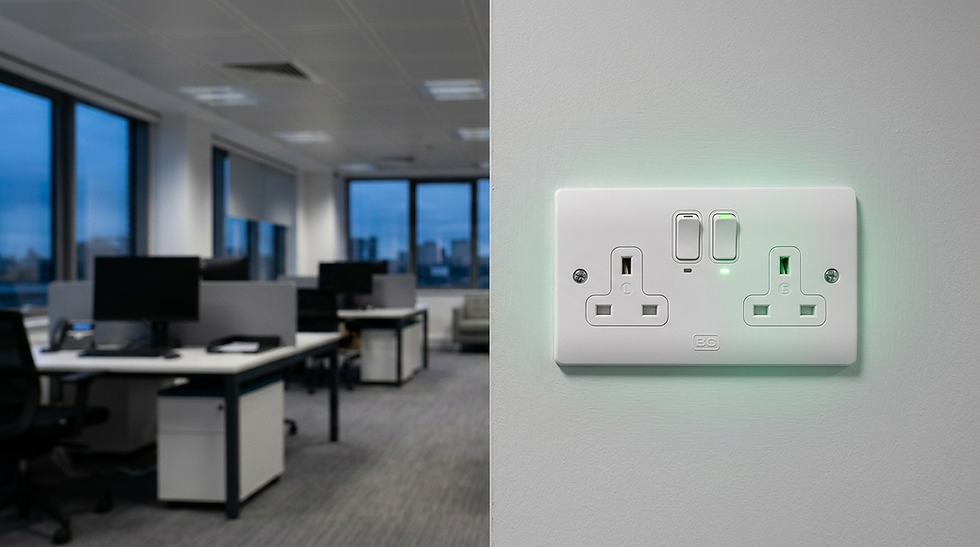
Smart sockets give facility teams automated, network-level control over small power, letting commercial operators eliminate standby power waste and schedule equipment shutdowns directly at the wall plate. By replacing standard electrical outlets with intelligent hardware, organisations monitor live circuit loads, automate shutdown policies, and lower baseline electricity costs without altering daily workplace routines.
Commercial buildings invest heavily in energy efficient HVAC systems, yet unmanaged plug sockets still drive substantial electricity waste outside core operating hours. According to the UK Green Building Council (https://ukgbc.org/solutions/a-smart-socket-to-reduce-emissions/), plug sockets can account for as much as 40% of a commercial building's total energy use, half of which is completely wasted energy from idle devices left on. Leaving computer monitors, catering equipment, water boilers, and display panels powered overnight inflates baseload draw across entire property portfolios.
Deploying smart sockets businesses can eliminate that baseline waste while gathering circuit-level data to meet corporate carbon emission reduction targets.
Key Takeaways
Direct-fit smart sockets eliminate out-of-hours small power waste without requiring rewiring.
Idle plug loads represent up to 20% of total commercial power consumption.
Circuit telemetry provides verified data logs for ESG and building compliance reporting.
Commercial installations routinely achieve full capital payback in under 12 months.
Why Pay for Unused Energy?
Commercial organisations pay for unused energy because unmanaged equipment draws background electricity whenever it remains plugged into live wall outlets. Devices left in standby mode overnight or across vacant weekends accumulate continuous kilowatt-hour charges. Operating automated socket switching eliminates this continuous financial loss by physically cutting circuit power outside business hours.
Background power draw creates an expensive baseline floor that facility managers cannot lower through central HVAC management alone. A typical commercial office contains hundreds of desktop peripherals, communal appliances, and display screens that draw current around the clock. These include, PC's, Monitors, TV's, Printers, Heaters, Fridges, Lights etc
As verified by Downlights Direct (https://www.downlightsdirect.co.uk/lightwave-smart-sockets-2-gang-13a.html), Lightwave 2 gang 13A smart sockets can be used as a direct retrofit replacement for standard UK 13A wall sockets without requiring additional wiring. Swapping passive faceplates for networked units allows maintenance teams to gain precise power control across large floorplates without structural delays.
What Are Smart Plugs Used For?
Smart plugs and sockets automate switching schedules and monitor power consumption for individual appliances across commercial properties. Building managers use them to isolate equipment overnight, verify operational health through current monitoring, and automate shutdown routines for workstation equipment, commercial catering appliances, communal hot-water boilers, and digital signage displays.
Targeted socket automation addresses specific operational demands:
Workstation desks: Switching off monitors, docking cradles, and task lighting at 19:00, restoring power at 07:00 on weekdays.
Concourses and hospitality: Isolating concession warmers and beverage chillers between events. According to Lightwave (https://lightwaverf.com/pages/commercial-results), retrofitting smart sockets and switches across hospitality and concourse areas at London Stadium reduced targeted energy consumption by 66% with a return on investment timeline of less than 12 months.
Machinery automation: Safe staging of workshop equipment. The University of Sheffield Advanced Manufacturing Research Centre (https://www.amrc.co.uk/news/smart-power-control-for-sustainability-unlocking-advanced-machinery-power-automation-for-smes) installed Lightwave smart power control technology at the AMRC North West complex in Preston to evaluate hardware design, system architecture, and regulatory requirements for machinery power automation.
How Do Smart Plugs Work?
A smart plug or socket uses an internal electromechanical relay paired with a wireless transceiver and current sensor. When mains power enters the socket, internal circuitry measures current draw and communicates with a central gateway. Software automation rules then tell the relay to open or close, cutting or restoring current to the appliance.
When an appliance draws power, the socket measures voltage and current signatures. If a device fails or consumes abnormal power, the system alerts facility engineers. Automated calendar profiles handle daily switching locally, ensuring that scheduled cut-offs occur even if the building loses internet connectivity.
Smart Sockets Businesses Can Deploy for Floorplate Efficiency
Commercial deployments require a structured operational sequence to capture maximum energy efficiency without interrupting core tenant activities:
Power Audit: Identify communal circuits and high-draw workstation banks where equipment runs idle overnight.
Phase-by-Phase Retrofit: Electricians replace existing faceplates into standard 35mm backboxes during planned maintenance windows, ensuring uninterrupted operations.
Control Grouping: Assign sockets to logical zones within management software, setting automatic cutoff schedules based on actual department hours.
Frequently Asked Questions
What is a smart plug?
A smart plug is an external adapter that sits between a standard wall outlet and an appliance power cable. It contains a wireless relay that allows building operators to turn connected electrical loads on or off remotely while measuring the real-time electrical energy usage of the attached device.
How do smart plugs differ from integrated smart sockets?
Smart plugs plug into an existing wall outlet, leaving them vulnerable to accidental unplugging or theft by building occupants. Integrated smart sockets replace the entire wall plate permanently, securing the switching mechanism and energy monitoring hardware behind the backbox for long-term commercial reliability.
Can smart sockets handle commercial catering equipment?
Standard UK smart sockets manage loads up to 13A (roughly 3,000W at 230V), making them suitable for countertop appliances such as water boilers and microwaves. Heavy cooking appliances with larger draws require dedicated industrial contactors connected to an external relay rather than direct socket switching.
Do smart sockets require specialised technical support to operate?
Most commercial smart sockets function through cloud consoles or local network gateways using standard web browsers, avoiding the need for dedicated on-site technical support. Facility managers set switching rules and extract compliance reports directly from central energy dashboards without complex software configurations.
Controlling Small Power Overhead
Leaving small power unmonitored commits a building to paying high commercial tariffs for idle hardware. Installing smart sockets brings small power under central management, cutting unnecessary baseline consumption and securing predictable operational savings.


Comments